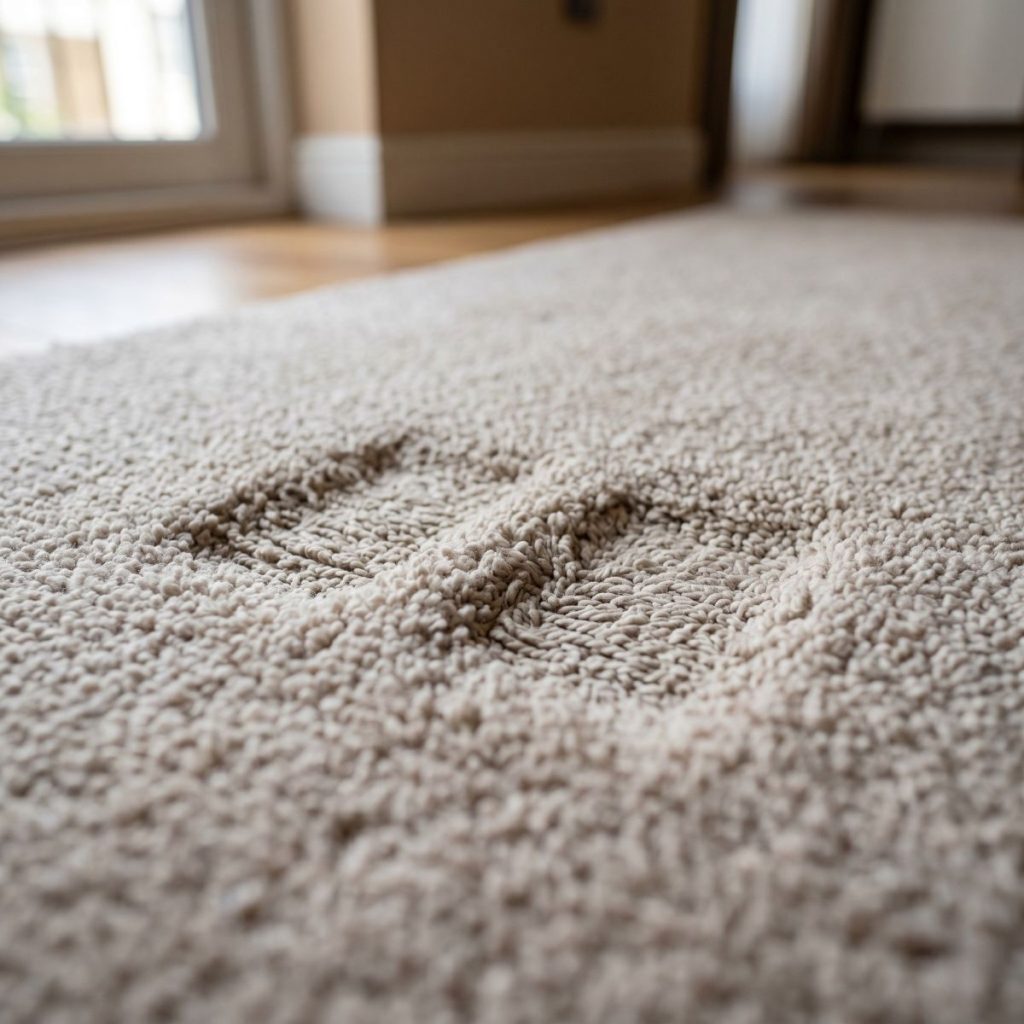
There is a very particular kind of heartbreak that arrives the moment you finally shift the sofa. You have spent the better part of a Sunday wrestling furniture across the room, you step back, hands on hips, ready to admire your handiwork like an estate agent on a property show – and there they are. Four deep, dimpled craters in the carpet where the sofa legs sat for the last three years, staring up at you like the ghosts of furniture past. I have seen this look of dismay on countless faces during my years cleaning homes across London, and I am here to tell you not to panic. Carpet dents are almost always temporary, and you very rarely need anything fancier than what is already lurking in your kitchen to sort them out. Let me walk you through exactly why they happen and how to coax your carpet back to life.
Why Furniture Leaves Those Annoying Dents in the First Place
Before we wade in with ice cubes and irons, it helps to understand what is actually going on down there in the pile. Your carpet is made up of thousands of little fibres standing to attention, and when you park something heavy on top of them – a wardrobe, a bookcase, a sofa that has seen better days – those fibres get squashed flat under the constant weight. Stay there long enough and they essentially forget how to stand up straight. It is a bit like what happens to your hair after you have worn a bobble hat all day, or the dent your head leaves in a pillow. The pile has been compressed, the air has been pushed out, and the fibres have settled into a sulk.
The good news is that this is, in most cases, a temporary state of affairs rather than permanent damage. The fibres have not snapped or worn away – they have simply been flattened. And flattened fibres can, with a little encouragement, be persuaded to spring back upright. Almost every method I am about to share works on the same simple principle: reintroduce a bit of moisture and warmth, and the fibres swell, relax and stand back up the way they were always meant to.
Not All Carpets Bounce Back the Same Way
It is worth knowing what you are working with before you start, because carpets are not all cut from the same cloth, so to speak. Synthetic carpets made from nylon or polyester are the springy, forgiving sorts – they have a natural resilience and tend to bounce back from dents with minimal fuss. These are the carpets that will happily survive a child, a dog and three house moves without complaint.
Natural fibres are a different beast entirely. Wool, sisal, jute and the like are gorgeous to look at and lovely underfoot, but they hold their grudges. They are more stubborn about releasing a dent and considerably more delicate when it comes to heat and moisture. If you have an expensive wool carpet or a natural-fibre rug, always start with the gentlest method you can and test a small, hidden patch first. There is no sense in fixing a dent only to scorch your pride and joy.
The Methods That Actually Work (Ranked by Effort)
Right, on to the main event. These are the fixes I have used and trusted over the years, and I have ordered them from the laziest to the most hands-on, so you can pick whichever suits your energy levels and the depth of your dents.
The Ice Cube Trick (The Lazy Person’s Favourite)
This is the method I reach for first, partly because it works beautifully on small to medium dents and partly because it requires almost no effort whatsoever. Pop an ice cube – or two or three for a larger dent – directly into the indentation and then walk away. Go and make a cuppa. Watch an episode of something. Let the ice melt completely, which can take an hour or more depending on the size.
As the ice slowly melts, the cold water seeps into the crushed fibres and they begin to swell and lift. Once the area is damp and the dent has started to relax, blot up any excess water with a clean towel so you are not left with a soggy patch, then gently fluff the fibres upright with your fingers or the edge of a spoon. Leave it to dry fully and you will often find the dent has vanished entirely. Magic, with absolutely no exertion required.
Steam Power – The Iron-and-Towel Method
For the deeper, more obstinate dents – the kind left by something that has not moved since the Blair government – you may need to bring out the big guns. Steam is wonderfully effective, but this is the method where my professional experience really earns its keep, so please read carefully.
Lay a clean, damp tea towel over the dent. Set your iron to its steam setting and hover it just above the towel, allowing the steam to penetrate through to the carpet beneath. The crucial word here is hover. Never, ever let the iron touch the carpet directly, and never let it linger. A few seconds at a time is plenty. Once you have steamed the area, lift the towel and fluff the warm, damp fibres back up with your fingers or a spoon.
A serious word of caution: this method is best kept for natural-fibre and wool carpets. Synthetic carpets can melt under direct heat, leaving you with a far worse problem than a dent – a permanently glazed, crispy patch that no amount of fluffing will fix. When in doubt, keep the heat low and the contact non-existent.
The Hairdryer Fluff-Up
If the thought of wielding a hot iron near your carpet brings you out in a cold sweat, the hairdryer method is a gentler middle ground. Lightly dampen the dented area with a spray bottle of water – you want it just misted, not drenched – and then blast it with your hairdryer on a medium-heat setting.
As you warm the fibres, use your free hand to tease and lift them upright, working against the direction in which they have been flattened. The combination of moisture, gentle heat and a bit of manual encouragement does a grand job, and you have far more control over the heat than you do with an iron. It takes a few minutes of patient fluffing, but it is well worth it, and there is something quite therapeutic about giving your carpet a blow-dry.
The Humble Edge of a Coin or Spoon
No matter which method you choose, the finishing flourish is always the same: a bit of gentle raking to bring the pile back to full attention. The edge of a coin, a spoon or even a stiff-bristled brush works a treat here. Once the fibres are damp and warm and relaxed, drag your chosen implement gently across the dent, lifting and combing the fibres upright.
It is a small, satisfying final step, and honestly the unsung hero of the whole operation. Plenty of dents that look only half-fixed after melting an ice cube come good entirely with a minute of careful raking. Do not skip it.
How to Stop the Dents Coming Back
Once you have your carpet looking respectable again, a little forethought will save you repeating the whole performance. The simplest trick is to use furniture coasters or cups under the legs of heavy items – they spread the weight over a wider area and dramatically reduce how deeply the fibres get crushed. You can pick them up cheaply, and they are practically invisible once the furniture is in place.
Beyond that, get into the habit of nudging your heavier furniture a couple of centimetres every so often. Just a small shift gives the compressed fibres underneath a chance to recover before they settle into a permanent dent. When you do your seasonal deep clean, consider rotating larger pieces or rearranging the room entirely, which I am rather a fan of anyway – nothing freshens a space like a good shuffle. And a regular vacuum across high-traffic areas keeps the pile lively and standing tall rather than matting down over time.
When to Wave the White Flag
I would be doing you a disservice if I pretended every dent comes out. Very old carpets, or cheaper ones with a low-quality pile, can develop permanent matting where the fibres have genuinely worn down rather than simply flattened. If you have tried the moisture-and-heat routine a couple of times with no joy, or if the dent is accompanied by visible fibre damage or fraying, you may be looking at something that home methods cannot fully reverse.
In those cases, a professional carpet clean can sometimes work wonders that a tea towel and an ice cube cannot, and for badly rippled or loose carpets, a proper stretching might be in order. There is no shame in it. Some dents are simply battle scars from a well-lived-in home, and a fully matted patch under a wardrobe that has not budged in a decade was always going to put up a fight.
So there you have it. The next time you rearrange a room and find yourself staring down a constellation of carpet craters, take a breath and remember that your fibres are far more resilient than they look. A bit of moisture, a touch of warmth and a kettle’s worth of patience will see off the vast majority of furniture dents, no specialist kit required. Carpets are made to be lived on, after all, and a few dents are simply proof that yours has been doing its job. Now off you pop and put that kettle on – your carpet, and probably you, have earned a brew.