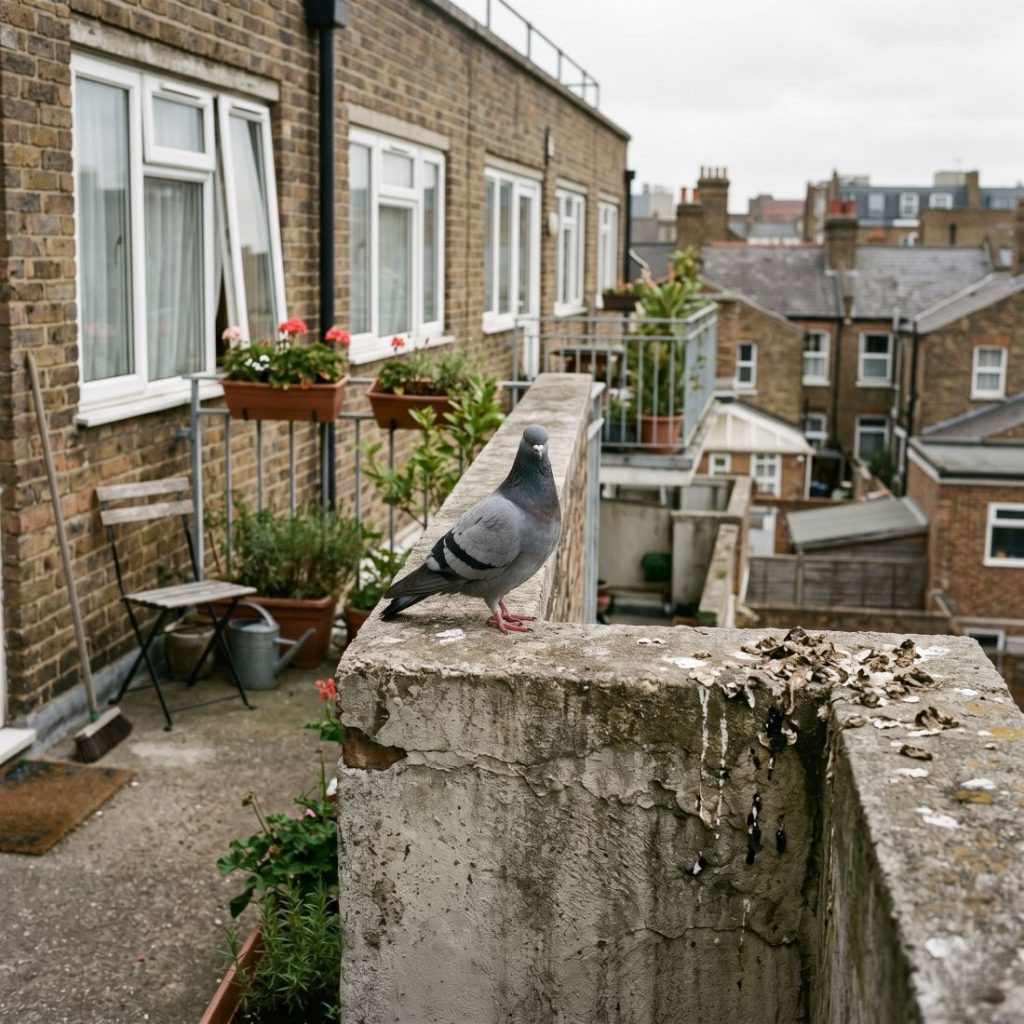
There is a unique flavour of London living that the estate agent never mentions on the viewing. You picture yourself out on your little balcony of an evening, glass of something chilled in hand, watching the city hum below. What you do not picture is the morning you slide open the door, mug of tea in hand, and discover that a flock of pigeons has, overnight, transformed your slice of urban paradise into what can only be described as an open-air lavatory. Streaks down the railings. Splatters on the floor. A suspicious crust on the back of your one nice chair. I have cleaned more pigeon-fouled balconies than I care to remember during my years working across the capital, and I promise you it is entirely fixable. It does, however, need doing properly and safely, so let me talk you through it.
Why Pigeons Treat Your Balcony Like a Five-Star Loo
It helps to understand that this is not personal, even if it very much feels like it. Pigeons are creatures of habit and comfort, and your balcony ticks every box on their wish list. It is high up, which makes them feel safe from cats and other ground-level threats. It usually offers a sheltered corner or a flat ledge, which is exactly the sort of cosy perch they adore. And once a pigeon has decided your railing is a good spot to roost, it leaves its calling card, and that calling card tells every other pigeon in the postcode that this is a safe place to settle.
That is the real kicker. Pigeons navigate partly by smell and by the droppings of their fellows, so a fouled balcony is essentially advertising itself as prime real estate. The longer you leave it, the more committed your feathered squatters become, and the more determined they are to defend their new headquarters. Which is all the more reason to deal with it promptly rather than pretending it will sort itself out, because it absolutely will not.
A Serious Word on Safety Before You Touch a Thing
I am normally the first to wave away fussiness, but this is the one cleaning job where I will not let you cut corners, because pigeon droppings are genuinely not something to be cavalier about. Dried droppings can harbour bacteria and fungal spores, and conditions such as psittacosis and histoplasmosis, while uncommon, are linked to breathing in the dust from disturbed droppings. The danger is at its worst when the muck is dry, because the moment you start sweeping or scraping at it, you send a cloud of fine particles straight up into the air you are breathing.
So the golden rule is this: never, ever dry-sweep or dry-brush pigeon droppings. Always dampen everything down first. Beyond that, kit yourself out properly before you begin. You want a pair of sturdy rubber gloves, a face mask (a proper FFP2 or FFP3 type rather than a flimsy paper one), and ideally some old clothes or an apron you can wash straight afterwards. If you wear glasses, all the better, and if you do not, a cheap pair of safety goggles is no bad thing either. None of this is me being dramatic – it is simply the difference between a job done sensibly and one you regret later.
Gather Your Cleaning Kit
Once you are suited and booted, get everything you need in one place so you are not traipsing through the flat mid-job with gloves full of who-knows-what. You will want a bucket of warm water, a generous squirt of washing-up liquid or a general-purpose cleaner, a stiff-bristled brush or an old broom kept solely for grim tasks, a plastic scraper or an old spatula for the stubborn bits, plenty of disposable cloths or kitchen roll, and a few bin bags. A watering can or a jug is handy for dousing, and if you happen to have access to an outside tap or a hose, even better.
The Clean Itself, Step by Step
Right, with the warnings out of the way and your kit assembled, let us get this balcony back to something you would willingly stand on in bare feet.
Step One: Soak Everything Down
Before you so much as touch a single splatter, drench the lot. Fill your watering can or jug with warm, soapy water and thoroughly wet down every fouled surface – the floor, the railings, the walls, the lot. The aim is to soften the dried droppings and, crucially, to stop any dust becoming airborne. Give it a good ten or fifteen minutes to soak in properly. This waiting bit is not optional; it is the single most important step for both safety and ease, because soaked droppings lift away with a fraction of the effort that dried ones demand.
Step Two: Scrape and Scoop
Once everything has had a proper soak, use your plastic scraper or spatula to lift away the worst of the solid deposits, scooping them straight into a bin bag as you go. Resist the temptation to scrub at this stage; you are just removing the bulk first. For the really baked-on crusts, a second dousing followed by another few minutes of patience works far better than brute force. Take your time and keep things damp throughout.
Step Three: Scrub the Surfaces
Now for the satisfying part. Armed with your stiff brush and your bucket of hot, soapy water, work methodically across the floor and up the railings, scrubbing in firm circles to shift the stains. Pigeon droppings are slightly acidic, so on stone, tile or painted surfaces they can leave a mark if they have been sitting a while, but a good scrub with a proper cleaner usually lifts the worst of it. Rinse your brush often and change your water the moment it turns murky, which it will, repeatedly. For glass balustrades, a separate cloth and a bit of glass cleaner at the end will get rid of the smears.
Step Four: Rinse and Disinfect
With the muck gone, rinse the whole area down with clean water to clear away the loosened residue and soap. Then go over the hard surfaces with a disinfectant suitable for outdoor use to deal with any lingering bacteria. Let it sit for the contact time stated on the bottle before a final rinse. Once everything has dried, peel off your gloves and mask, bag them up with your disposable cloths, tie the bin bag tightly, and give your hands a thorough wash. Then, and only then, are you allowed your cup of tea.
Keeping the Pigeons From Coming Back
A spotless balcony is a hollow victory if your visitors return the following night and start the whole sorry cycle again, so deterrence is half the battle. The most effective approach is to make your balcony a far less appealing place to perch. Anti-roosting spikes along railings and ledges are the classic solution, and despite how they look, they do not harm the birds; they simply make landing uncomfortable enough that the pigeons go elsewhere.
There are gentler options too. Pigeons dislike shiny, moving objects, so strips of reflective tape, old CDs strung up, or even a few foil streamers fluttering in the breeze can work surprisingly well, at least for a while. Some people swear by a fake owl or hawk, though I will warn you that London pigeons are a worldly, streetwise bunch and tend to rumble a stationary plastic predator within a week or two, so move it about if you go down that route. Keeping the space clean and tidy helps enormously as well, since clutter offers shelter and a freshly cleaned surface no longer carries that come-hither scent of previous droppings.
When It Is More Than a Cleaning Job
Occasionally you will find the pigeons have moved past casual loitering and have actually built a nest on your balcony. Here you need to tread carefully, and not just because of the mess. In the UK, wild birds, their active nests and their eggs are protected under the Wildlife and Countryside Act 1981, which means you cannot simply remove an occupied nest or disturb eggs once they have been laid. The sensible move is to act before nesting begins, clearing perching spots and fitting deterrents early in the year. If you discover an established nest with eggs or chicks, your best bet is to leave it be until the young have fledged and then clean and deter, or to seek advice from a professional pest controller who knows the rules. It is a faff, I grant you, but it is the law, and the birds were rather just doing what birds do.
So there it is. A pigeon-claimed balcony feels like a grim discovery, but with the right precautions, a good soak and a bit of elbow grease, you can reclaim your outdoor space and send the freeloaders packing. The trick is to clean it safely, clean it thoroughly, and then make the place thoroughly uninviting so you are not back out there next weekend doing it all over again. London will always have its pigeons; your balcony does not have to be their en suite.